Understanding Cape Coral's Unique Ground Challenges
Cape Coral sits on some of Florida's most challenging terrain for concrete construction. Unlike northern states with stable clay and compacted soil bases, Cape Coral was built on dredged canal fill and native sandy soil that shifts, settles, and compresses over time. When developers created the canal system that defines Cape Coral's landscape, they used whatever material was excavated to fill residential lots. This meant sand, shells, and loose fill became the foundation for thousands of homes and driveways.
The problem isn't immediately obvious. Your concrete driveway might look perfectly fine during the first year or two of ownership. But as the sandy fill beneath settles, as moisture penetrates and destabilizes the subgrade, and as Florida's water table rises and falls seasonally, your concrete begins to move. That movement creates stress, and stress leads to the cracks, settling, and failure that so many homeowners experience. This isn't a defect in the concrete itself, but rather a consequence of building on ground that was never designed to support rigid slabs.
How High Water Table and Slab Cracking Are Connected
Florida's high water table is one of the most underestimated factors affecting concrete durability. In Cape Coral, the water table can be just a few feet below the surface, especially in areas near canals or during wet season months. When water rises into the sandy fill beneath your concrete slab, it weakens the base, reduces bearing capacity, and causes the soil to become unstable. This is particularly problematic because sandy soils offer little structural support when saturated, unlike clay-based soils found in other regions.
Slab cracking from high water tables happens in stages. First, the water-saturated sand loses its ability to support the concrete evenly. Then, as water recedes during dry periods, the soil shrinks and creates voids. Your concrete, which is rigid and cannot flex, develops cracks as it settles into these voids. Over months and years, these cracks grow wider, water seeps deeper, and the problem compounds. Many homeowners assume their concrete is simply defective, when in reality the real culprit is the ground beneath it. This is why professional assessment matters before pursuing any Concrete Repair & Resurfacing solution.
Sandy Fill Concrete Settling: Why Your Driveway Is Sinking
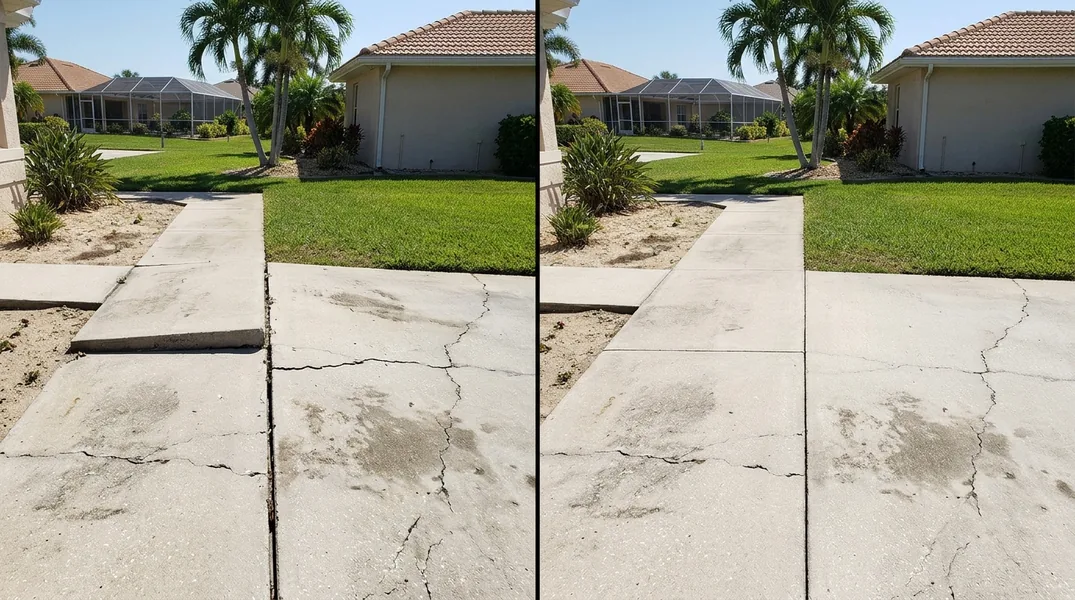
Sandy fill concrete settling is perhaps the most common complaint we hear from homeowners across Cape Coral. When you notice your driveway has settled unevenly, with one section lower than an adjacent section, you're witnessing the result of differential settling in the sandy subgrade. The fill material was never properly compacted to modern engineering standards, so it continues to compress under the weight of your vehicle and the concrete itself.
This settling isn't uniform. Some areas of your driveway may sink an inch or more while adjacent sections remain relatively stable. The result is a tripping hazard, poor drainage that allows water to pool on the surface, and accelerated deterioration. Pooled water penetrates cracks, freezes and thaws (though rare in Florida, it does happen), and further destabilizes the base. What started as minor settling becomes a safety issue and an eyesore. The good news is that Concrete Repair & Resurfacing options exist, from mudjacking and polyurethane injection to complete replacement, depending on the severity and your budget.
When to Pursue Concrete Repair vs. Replacement
Not every cracked or settled driveway needs to be torn out and replaced. Understanding the difference between repair-worthy damage and replacement-level failure will help you make a smart financial decision. Minor cracks (less than one-quarter inch wide) and slight settling (under half an inch) can often be addressed with Concrete Repair & Resurfacing techniques that stabilize the base and seal the surface against further water intrusion. These solutions are less invasive and significantly less expensive than full replacement.
However, if your driveway has multiple large cracks, severe settling with trip hazards, or signs of structural failure, replacement may be the only viable long-term solution. The advantage of replacing your driveway is the opportunity to address the underlying soil issues. A professional contractor can recommend proper site preparation, improved drainage, and better subgrade compaction to prevent the same problems from recurring. Before making this decision, contact Cape Coral Concrete at (239) 323-5329 to discuss your specific situation and get a professional assessment that includes the true cause of your concrete's failure.
Concrete Driveways in Cape Coral: Building for Longevity
If you're planning a new Concrete Driveways project or replacing an existing one, understanding how to build for Cape Coral's specific conditions is essential. Proper site preparation is the foundation of everything. This means removing unsuitable fill, compacting the remaining sandy soil in layers, and installing a stable base course. Many contractors skip these steps to save time and money, which is exactly why so many driveways fail prematurely in this area.
Drainage is equally critical. Your Concrete Driveways should slope slightly to direct water away from the slab and the foundation of your home. Subsurface drainage systems, including perforated pipes and gravel layers, help manage the high water table and prevent saturation of the subgrade. Additionally, using proper concrete mix design for Florida's climate, including air entrainment for the rare freeze-thaw cycles and corrosion-resistant reinforcement, adds years to the lifespan of your driveway. When you invest in quality construction from the start, you avoid the costly repairs that plague so many Cape Coral properties.
What to Budget for Concrete Repair in Cape Coral
The cost of addressing concrete settling and cracking varies widely depending on the extent of damage, the repair method chosen, and the size of the affected area. Minor repairs and crack sealing might cost a few hundred dollars, while mudjacking or polyurethane injection to lift a settled section could range from one thousand to several thousand dollars. Full driveway replacement, of course, represents the largest investment. Understanding the pricing for different repair approaches will help you plan your budget responsibly.
The most important step is getting an accurate assessment of your concrete's condition and the underlying cause of the damage. Cape Coral Concrete offers a free estimate for homeowners dealing with concrete settling, cracking, or other damage. During this evaluation, we identify whether your concrete can be repaired or whether replacement makes more sense for your situation. Contact us at (239) 323-5329 or visit our website to schedule your assessment. Addressing concrete problems early, before they worsen, typically results in lower overall costs and better long-term outcomes for your property.
Looking for a professional concrete contractor in Cape Coral? Cape Coral Concrete responds fast for all your concrete needs.
Get a Free QuoteOur services: Concrete Driveways · Concrete Patios · Stamped & Decorative Concrete