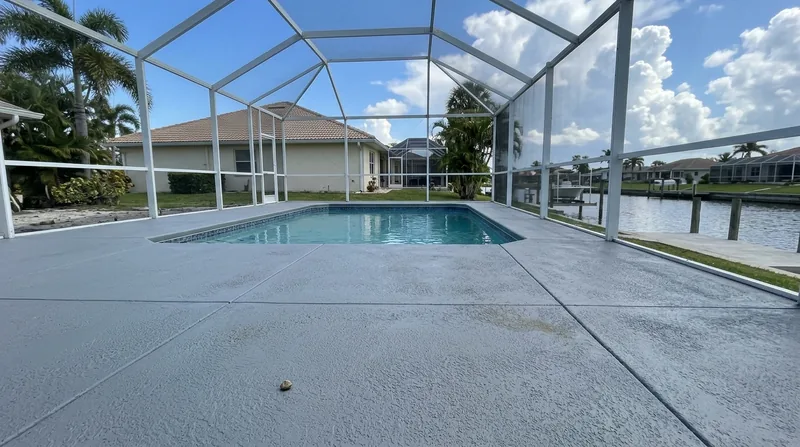




In Cape Coral, nearly every backyard centers on a screened pool cage set over a concrete deck. These decks take a beating from year-round heat, intense UV rays, daily afternoon thunderstorms from June through September, salt air that corrodes exposed rebar, and algae that thrives on shaded surfaces. Whether your deck is original 1960s flatwork settling into sandy fill, or a newer pour that's cracked and slippery underfoot, concrete pool decks in Cape Coral demand slip-resistant finishes and proper drainage to handle the subtropical climate and the region's high water table. We pour new decks and resurface existing ones with broom, textured, or decorative finishes that stay cooler in direct sun and provide safe footing even when wet. The right pool deck complements your home's value, extends your outdoor living space, and protects your family and guests from slip hazards that are especially dangerous around water.
Why Your Pool Deck Fails in Cape Coral: Heat, Water, and Sandy Foundations
Cape Coral's pool decks sit on sandy fill dredged from the canals, compacted over shell and shallow limestone. The high water table and year-round moisture mean that poorly compacted fill settles, seawalls behind patios wash out, and slab edges undermine over time. Add intense UV that breaks down concrete sealers, algae that accumulates on shaded decks near screened cages, and the corrosive salt air near the Gulf, and you get cracking, fading, and slippery surfaces that need resurfacing or replacement every 10 to 15 years. A well-installed deck with proper slope, reinforcement, and a slip-resistant finish stops these problems before they start.
- Concrete settles into sandy fill, creating sunken edges and trip hazards around the perimeter.
- High water table and summer rains cause efflorescence, white mineral staining, and surface breakdown.
- Algae and mildew thrive on shaded surfaces under screened cages, making decks dangerously slippery.
- UV exposure fades sealers and weakens the concrete surface, especially on south and west-facing decks.
- Salt air near waterfront properties corrodes rebar and accelerates concrete deterioration.
Understanding these failure modes helps you choose the right finish and maintenance plan for your deck.
Key info: A homeowner in the Yacht Club area of Southeast Cape noticed her 1970s pool deck settling unevenly and developing hairline cracks after a heavy rainy season. We removed the old deck, reinforced the base with properly compacted fill and rebar, and poured a new textured slab with a broom finish that sheds water and resists algae better than the original smooth concrete. The new deck slopes toward the pool and a drain, eliminating standing water and the mildew that plagued the old surface.
For more on how water and settlement affect all your concrete surfaces, see our page on concrete leveling and slab lifting in Cape Coral.
How We Build and Resurface Pool Decks in Cape Coral
Our process starts with a site visit to assess the deck's current condition, drainage, and the surrounding landscape. For new decks, we excavate, compact the subgrade, install rebar and proper slope, and pour 4 inches of 3,000 PSI concrete. For resurfacing, we grind or shot-blast the old surface to remove algae, loose concrete, and sealers, then apply a new wearing course with your choice of finish. We always slope the deck toward the pool or a perimeter drain so water doesn't pond, and we use air entrainment and slip-resistant aggregates to handle Cape Coral's freeze-free but UV-intense environment.
- We excavate and compact the subgrade properly to prevent future settling in sandy Cape Coral soil.
- We install rebar and wire mesh reinforcement, sized for the deck's load and local conditions.
- We pour 4-inch concrete with air entrainment and fiber reinforcement to resist thermal cracking.
- We finish with broom, textured, or decorative options that provide slip resistance and aesthetic appeal.
- We slope the deck 1/8 inch per foot toward the pool or a perimeter drain for positive drainage.
- We cure the concrete properly and apply a penetrating sealer to resist UV, salt air, and algae.
This systematic approach ensures your deck stays safe, level, and attractive for years to come.
Local example: A home in Cape Harbour with a barrel-tile roof and a large screened pool cage had a cracked, algae-stained 1990s deck. We removed the old slab, reinforced the base with compacted shell and limestone, and poured a new 800-square-foot deck with a light-gray broom finish and proper slope. We also sealed it with a UV-resistant product to keep the color stable and to slow algae growth. The homeowner now has a bright, slip-resistant deck that complements the home's Mediterranean aesthetic.
Learn more about our concrete repair and resurfacing services for decks and other flatwork.
Concrete Pool Deck Finishes: Broom, Textured, and Decorative Options
| Finish Type | Description | Best for |
|---|---|---|
| Broom Finish | Light bristle pattern swept into wet concrete, providing slip resistance and a clean, simple look. | Budget-conscious homeowners who want safety and durability without decorative cost. |
| Textured Finish | Aggregate exposed by grinding or pressure washing, creating a rough, tactile surface that resists algae and stays cooler underfoot. | Cape Coral homeowners in humid, shaded areas where algae thrives and heat reflection is a concern. |
| Stamped Concrete | Patterns and colors pressed into wet concrete to mimic stone, brick, or tile while maintaining concrete's durability and slip resistance. | Homes with high-end landscaping, stone patios, or decorative hardscapes that need visual continuity. |
| Polished Concrete | Ground and sealed to a high gloss, exposing aggregate and creating a modern, sleek appearance with excellent durability. | Contemporary homes, decks visible from inside screened cages, and areas where light reflection and easy cleaning matter. |
Each finish offers different levels of slip resistance, maintenance, and aesthetic impact. Your choice depends on your home's style, the deck's exposure to sun and shade, and how much algae pressure you expect from Cape Coral's humid subtropical climate.
Concrete Pool Decks Cost in Cape Coral: What to Expect
Concrete pool deck pricing in Cape Coral starts at around $8 per square foot for a basic broom-finished new pour, and ranges up to $15 to $20 per square foot for textured, stamped, or polished finishes with premium sealing. Resurfacing an existing deck typically costs $5 to $12 per square foot, depending on the condition of the old surface and the finish you choose. Several factors move the price up: the size of the deck, the condition of the subgrade and whether we need to remove and replace undermined slabs, access for equipment and concrete trucks, proximity to the pool and landscaping, whether you need drainage improvements, and the complexity of the finish. A small 300-square-foot deck might run $2,400 to $6,000 new, while a large 1,200-square-foot deck with decorative finishes and sealing could reach $18,000 to $24,000. Getting 2 or 3 estimates from insured contractors helps you understand the scope and avoid low-ball bids that skip proper base prep and lead to settling and cracking.
For a detailed breakdown of our pricing and what's included at each level, visit our full pricing overview.
What to Look for When Hiring a Concrete Contractor Near Cape Coral
Hiring the right contractor for your pool deck is as important as choosing the right finish. You want someone who understands Cape Coral's sandy soil, high water table, salt air, and algae pressure, and who can deliver a deck that drains properly and resists UV and moisture damage. Start by checking that the contractor carries current general liability insurance and workers' compensation coverage on every job. Ask for a certificate of insurance and verify that coverage before work begins. Request references from recent pool deck projects in Cape Coral, Bonita Springs, or nearby areas, and call at least two to ask about the quality of the finish, how well drainage works, and whether the deck has held up over one or two rainy seasons. Get written estimates from 2 or 3 contractors that itemize the scope, materials, finish, sealing, and timeline. Ask about permit requirements in your neighborhood or HOA, as some Cape Coral developments have specific rules about concrete color, texture, or pool cage modifications. A reputable contractor will pull any required permits and handle inspections, saving you hassle and ensuring the work meets local code.
Ready to move forward? Contact us for a free estimate, no obligation. We respond within 24 hours at (239) 323-5329.
Concrete Pool Decks in Cape Coral: Pricing Guide
| Service | Price | Details |
|---|---|---|
| Broom Finish New Deck | Starting at $8/sq ft | Basic slip-resistant finish, proper slope and drainage, standard 4-inch concrete with rebar reinforcement included |
| Textured or Decorative Finish | Starting at $12/sq ft | Exposed aggregate, stamped patterns, or polished surface with premium sealer; cost varies by finish complexity and deck size |
| Deck Resurfacing or Grinding | Starting at $5/sq ft | Grinding old surface, algae removal, new wearing course applied; price depends on existing condition and new finish type |
| Base Prep or Subgrade Replacement | On estimate | Required when old deck is settling, undermined, or subgrade is poorly compacted; needs on-site assessment before pricing |
| Travel and Site Visit | Included | No separate charge for travel within Cape Coral and surrounding service areas; free initial inspection and estimate within 24 hours |
| Free Estimate | No obligation | Written quote with itemized scope, materials, finish options, timeline, and permit details; call (239) 323-5329 to schedule |
Indicative pricing, the exact cost depends on square footage, finish, and site access. Free personalized estimate within 24h at (239) 323-5329.


